Page 1 of 1
About electron self-energy in phonon-assisted optical absorption calculation
Posted: Mon Jan 26, 2026 2:49 am
by lyzhao
Dear all,
I am confused by the electron self-energy in phonon-assisted optical absorption calculation.
I have checked many references, but I couldn't find the calculation relationship between the absorption coefficient and the self-energy (calculated by EPW). I guess it is related to the calculation of energy levels \varepsilon .
My question is that I used the GW calculation results (which include the self-energy calculation and incorporate it into the energy level by perturbation), and now I want to know how the electronic self-energy (including electron-phonon interactions) is incorporated.
Any help will be appreciated.
Best regards.
Youzhao Lan
Zhejiang Norm. University.
China
Re: About electron self-energy in phonon-assisted optical absorption calculation
Posted: Fri Jan 30, 2026 6:15 pm
by xiaozha
Hi Youzhao,
Thank you for the question. I'm assuming you are talking about the broadening parameter on the denominator of the matrix elements in e.g. Phys. Rev. Lett. 108, 167402?
The short answer is, this broadening parameter should not be directly related to the electron self energy, but more as a numerical broadening to avoid divergence of the denominator. It is a limitation of second-order perturbation theory, and will happen when phonon-assisted absorption happen in the same regime direct absorption can happen. If you are in the indirect regime (for example, if one calculates the absorption coefficient of silicon in the regime of ~1.2 eV to 3 eV), one will see that the absorption will not depend on this parameter (until it becomes large).
Tricks can be used to avoid this divergence, and one example would be e.g. ACS Nano 2016, 10, 1, 957–966, Eq. 10, but it is more of numerical way. More physically what one can do is considering the quasi-degenerate perturbation theory in the indirect-direct resonant region, see: Phys. Rev. B 109, 195127. We are also considering the problem in the context of many-body perturbation theory, which may provide a way to incorporate the physical self energy into the equation but it is still in very early stages and not yet implemented into EPW.
Thanks!
Xiao
Re: About electron self-energy in phonon-assisted optical absorption calculation
Posted: Sat Jan 31, 2026 2:42 am
by lyzhao
Dear xiaozha,
Thanks for your help.
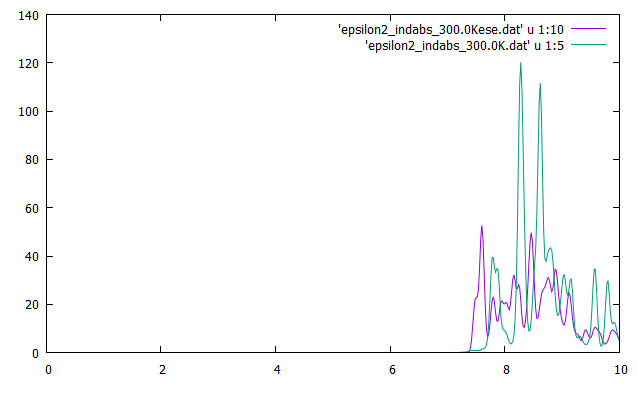
I am sorry for not providing sufficient information. Simply, my question is: How does the elecselfen parameter affect the phonon-assisted optical absorption calculation ? I compared the graphs, and it seems to affect more than just the broadening factor. The peak positions have also changed. see the attached file and the following figure as an example.
epsilon2_indabs_300.0Kese.dat for elecselfen = .true. and epsilon2_indabs_300.0K.dat = .false.
- 1.png (21.71 KiB) Viewed 42629 times
Best regards.
Youzhao Lan
my input file:
Code: Select all
&inputepw
  prefix      = 'pw'
  outdir      = '../scf4epw'

  elph        = .true.
  epbwrite    = .false.
  epbread     = .false.
  epwwrite    = .false.
  epwread     = .true.
  etf_mem     = 1

!  band_plot = .true.

  mp_mesh_k = .true.
  lindabs = .true.
  efermi_read = .true.

  !~ fermi_energy =-3.5
  !~ eig_read    = .false.
  !~ omegamin = 3.0
  !~ omegamax = 7.0
  !~ omegastep = 0.02

  fermi_energy = 2.5
  eig_read    = .true.
  omegamin = 0.0
  omegamax = 10.0
  omegastep = 0.02


  elecselfen  = .true.
  phonselfen  = .false.
  a2f         = .false.

  fsthick     = 8 ! eV
  temps       = 300 ! K
  degaussw    = 0.05 ! eV

  dvscf_dir   = '../scf4ph/save'

  nkf1        = 30
  nkf2        = 30
  nkf3        = 1
  nqf1        = 15
  nqf2        = 15
  nqf3        = 1

  nk1         = 24
  nk2         = 24
  nk3         = 1
  nq1         = 12
  nq2         = 12
  nq3         = 1


  nbndsub     =  8

  use_ws      = .true.
  asr_typ     = 'crystal'


  wannierize  = .false.
 /
Re: About electron self-energy in phonon-assisted optical absorption calculation
Posted: Mon Feb 02, 2026 4:27 pm
by xiaozha
Hi Youzhao,
Thanks for the clarification. Interestingly I believe that setting the elecselfen is not supposed to affect the calculated optical spectra. i.e. setting elecselfen does calculate the real and imaginary part of electron-phonon limited electron self energy, but I don't think these are used to actually correct the energies used to evaluate optics. The energies for optics should remain what they are as you provided from GW.
A few things to note and potentially to try to diagnose:
-From the input, your system also seems to be a 2D material. I believe optics module in EPW does not yet correctly handle 2D system as volume of the unitcell is used to evaluate the spectra, which is not meaningful if one has a vacuum. Also, from the spectra you got, it seems like the indirect regime is somewhere below 7.2 eV and then one starts to enter the direct regime? If so, anything above that energy should not be trusted - as I mentioned, evaluating indirect absorption via perturbation theory experience a divergence as long as one reaches the direct absorption regime.
-On the other hand for electron self energy, from the output it seems both the imaginary part and real part of the self energies are quite large. Maybe it would be helpful to check the Wannierized band structure and phonon dispersion to see if anything funny is happening there.
-I'm also suspecting that the fine grid is underconverged (which may also result in the unusually large self energies). So potentially trying to converge that a bit further might help.
Separate from those, another thing to double check is if your material is a polar material. If so, it is important to have the tag lpolar to make sure the analytical Frohlich term is treated properly.
Thanks!
Best,
Xiao
Re: About electron self-energy in phonon-assisted optical absorption calculation
Posted: Mon Feb 02, 2026 11:30 pm
by lyzhao
Dear Xiao,
Great thanks for your help.
Best regards
Youzhao Lan.